


On May 14, 2026, Peking University HSBC Business School UK Campus (PHBS-UK) hosted an insightful dialogue session, featuring Nobel Laureate Professor Thomas J. Sargent. Moving away from the traditional lecture format, the event was designed as an open conversation, giving students the chance to engage directly with one of the most influential economists of our time.
About Prof. Thomas J. Sargent
Honorary Director of Sargent Institute of Quantitative Economics and Finance at PHBS, W.R. Berkley Professor of Economics and Business at NYU. Awarded the 2011 Nobel Prize in Economics for his foundational research on structural macroeconometric methods to analyse the causal effects in the macroeconomy.
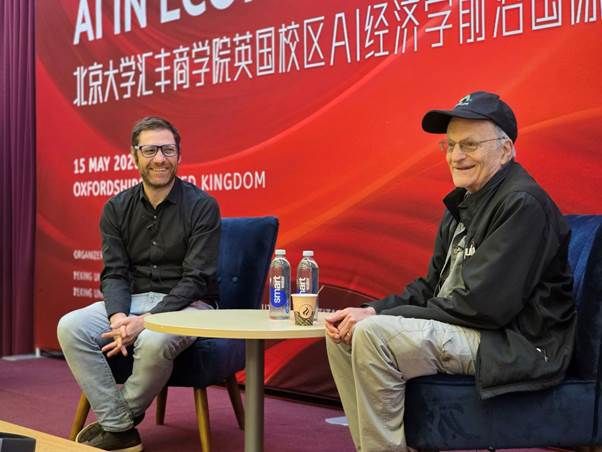
Sargent shares an anecdote on economics and AI
Professor Sargent started off the discussion session with an anecdote of a prior discussion about economics, proposing an imperialist view of economics as a subject. He began by asking the students what they believed economic theory and economics was. Professor Sargent then linked these ideas to Artificial Intelligence (AI) and Machine Learning, commenting on the nature of economic forecasting and prediction models. He talked a little about the history of Machine Learning's development and how the increasing technological capabilities are allowing researchers to answer more complex questions and develop more sophisticated models.
Professor Sargent then refocused back to economics as a study by interrogating some previously held assumptions and definitions, including the concept of individuality and personhood. As a result of pushing the audience and challenging students to re-evaluate these concepts, a unique definition was proposed: a person can be understood as a constrained function. This idea was then expanded to the level of organisations, then nations and beyond, with professor Sargent challenging the audience to reevaluate definitions of each concept along the way. The students were invited to explore and extrapolate upon ideas discussed during the conversation. Professor Sargent expanded upon these ideas and explained related concepts with examples and anecdotes. He inspired the room to draw parallels between economic theory and other fields of study, bringing economics closer to the audience.
As the discussion continued, the conversation flowed into the topic of Machine Learning. To explain the concept of Artificial Intelligence, professor Sargent recounted a story about the difference between intelligence in the form of perfect memory, recall and perception to intelligence in the form of simplification, choice and judgement. Comparisons were made between the story’s overall metaphor and the interplay of humans and machines today. The role of human intelligence and judgement was discussed, including how it interacts with and influences artificial intelligence. The idea of subjectivity and its meaning within this technological landscape was also explored, including how some subjective thoughts and actions transform into objective results with measurable impact.
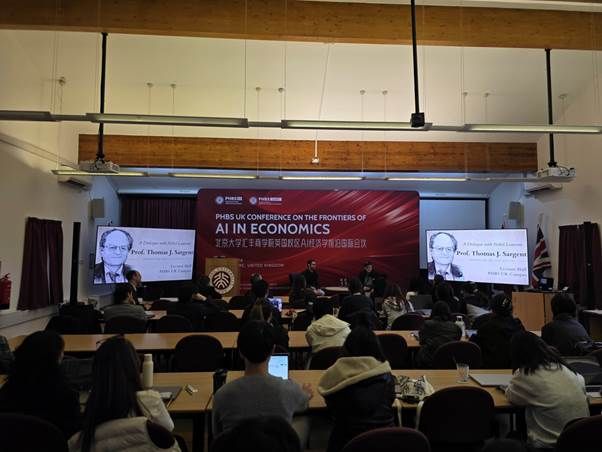
PHBS-UK students in conversation with Sargent
Throughout the discussion, questions were posed about the usage of AI in education, as well as its impact on students' learning and development. Professor Sargent clarified his views about the role of AI and Large Language Models (LLMs) in today’s society. He recognised the benefits of the increased computing capabilities of machines today, and how technological advancement can help push boundaries of human capability further. Clarifications were made about how AI in the form of advanced Machine Learning is being used in his current research. At the same time, he expressed concern about their impact on other aspects of society and human function. Particularly some concerns were raised about the increasing possibility of over-dependence on AI within everyday life, and the potential difficulty in decoupling from it. The possible effects and feasibility of regulation was also discussed, as well as the dilemma such decisions pose to leaders.
This discussion event offered a unique opportunity for students to learn from and connect with one of the most influential economists of our time through dialogue. The open dialogue encouraged the students to freely engage with Professor Sargent and explore ideas in a more relaxed setting.
Edit by Jing Li, Dominic Richard, Jiao Shi
Photo: Bing Han

