


On March 11, 2026, Peking University HSBC Business School UK Campus (PHBS-UK) hosted an interesting and intriguing session of its Research Seminar Series, featuring Dr. Yiting Deng from University College London. The research seminar, titled “Holiday or Hangover? Housing Market Responses to a Temporary Tax Cut” focused on how temporary tax cuts affect housing market behavior. The research seminar was moderated by Dr. Chaoran Liu, Assistant Professor in Management at Peking University HSBC Business School.
Speaker Profile

Yiting Deng is an Associate Professor of Marketing & Analytics at the UCL School of Management, University College London. Prior to joining UCL, she was an Assistant Professor at the University of Notre Dame’s Mendoza College of Business. She received her PhD in Marketing and MS in Statistics from Duke University. She also holds Bachelor’s degrees in Economics and Statistics and a Master’s degree in Economics from Peking University.
Yiting’s research focuses on digital platforms and advertising. Her work has been published in leading academic journals such as Marketing Science, Management Science, Journal of Marketing Research, Production and Operations Management, Journal of Operations Management, among others. Her research on advertising targeting was recognized as a finalist for the Weitz-Winer-O’Dell award, the Don Lehmann Award, and the Robert D. Buzzell MSI Best Paper Award. She currently serves as an Associate Editor for Decision Science, Service Science, and the Journal of Business Research, and is a member of the editorial review board for Marketing Science.
Yiting currently teaches the Marketing core course on the UCL–PKU MBA program and the Digital Marketing course on UCL’s MSc Marketing Science program. Previously, she taught Marketing core courses on UCL’s BSc Management Science and MSc Management programs, and at the University of Cambridge and the University of Notre Dame. She was recognized as one of Poets & Quants World’s Best 40-under-40 Business School Professors in 2022 and received the UCL School of Management Best Teacher Award in 2023.
Dr. Deng began the seminar by introducing the background for this research, including background about the housing market and tax reform. She introduced the issue of changing tax policy and how the resulting uncertainty causes buyers and sellers to be reluctant to make moves. Then Dr. Deng further expanded on the role of housing as well as the taxes and costs associated, explaining the different taxes associated with the housing market and how the system can discourage mobility within the housing market. She also explains how modifications to government tax policy influence behavior, focusing on the effects of a tax reduction during the 2019 Covid pandemic. Dr Deng also introduced some existing literature on the effect of taxes on housing prices, and the conflicting results of prior literature.
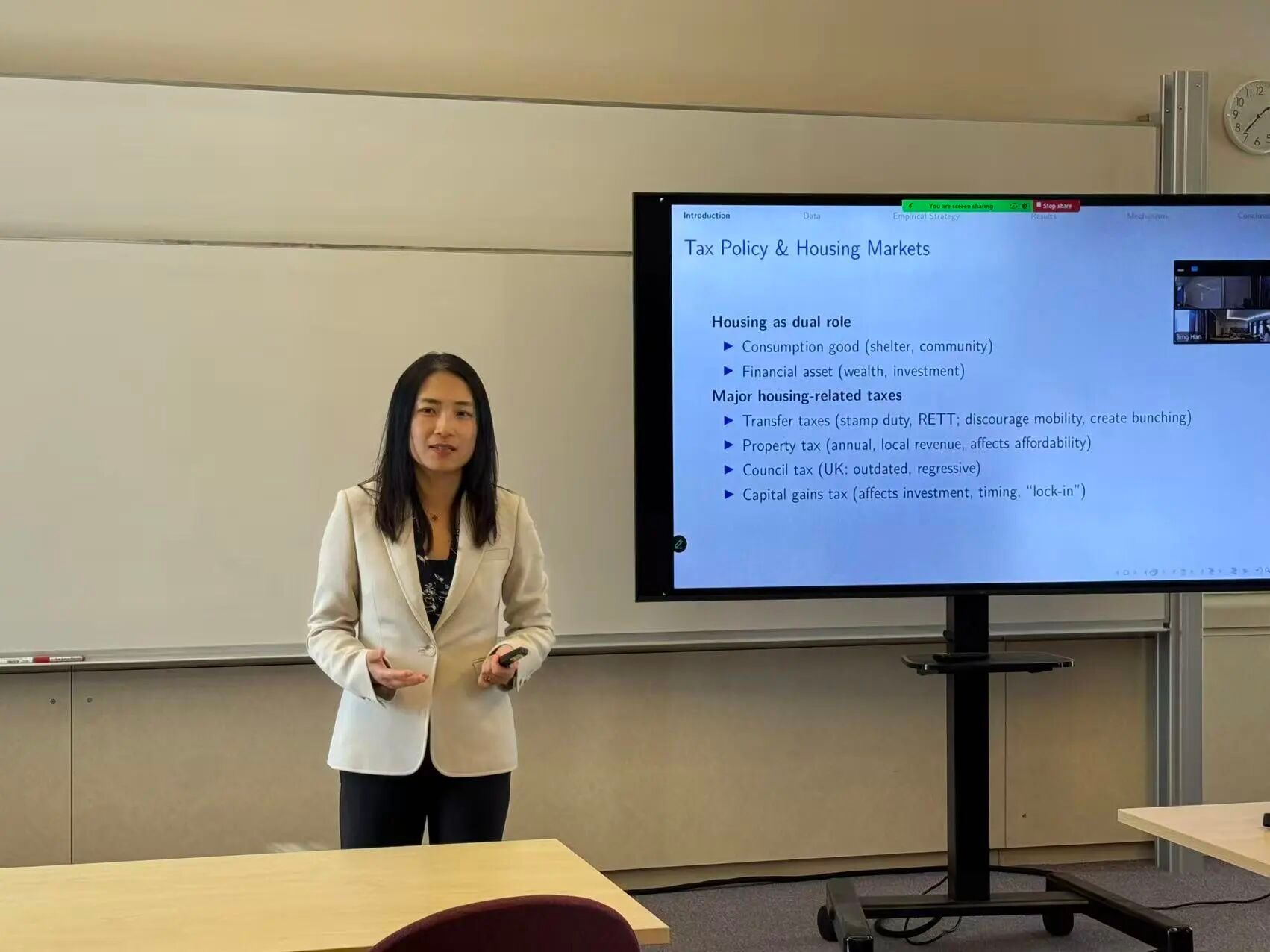
With the background introduced, Dr Deng raised the question: “If taxes discourage market mobility, would the removal of this barrier benefit buyers by theoretically making housing more affordable?”
To answer this question, Dr Deng first explains the particular progressive tax that was temporarily adjusted in 2019, in response to the pandemic-driven market slowdown, where a housing stamp tax exemption was increased from 125,000 to 500,000 pounds. As expected, the housing market was stimulated, with the market seeing high growth during the tax-holiday. Then Dr. Deng described the research and its three primary goals. The first was to uncover the short run effects of the tax reform, meaning how it affected price liquidity and market behavior. The second being the long-run effects, and seeing if the short-run effects translate into improved resale performance. Finally, the study also looked into possible heterogeneity and whether certain effects were congregated in certain areas.
The study was done using data from housing market listing data via data-scraping as well as purchased data. The research observed clickstream data to see mechanisms via cookies, logins, as well as track listings through their lifecycle. Property sales including transfer price were also connected to UK land registry transaction data to confirm transactions. Data was collected on a sectional level, with examinations on the listing level to track individual listings, as well as the selling level to account for a single seller working with multiple agents and relisting behavior.
Empirically, the study used PSM-DiD methods to compare the variations within data, with acknowledgement to differences in market behavior at different price points, property types, locality, and how affected the properties were by the policy change. Properties were matched by exact matching of similar features to ensure compatibility. Data was also collected for short term results, spanning a year before and after the policy change, as well as long term, spanning around three years.
Results of the study showed some surprising results. Overall results identified significant listing price and transfer price variations after the policy change. Key interesting results were that the tax-reduction did not translate into better returns for buyers, due to an increase in transaction prices during the temporary tax discount. Dr. Deng explained several factors that have contributed towards this. These included increases in asking price as well as transfer price. Explanations included sellers translating the tax-savings into higher listing prices, as well as buyers being more willing to pay closer to listing prices during the tax-discount timeframe. Other notable findings were that areas of higher local deprivation showed stronger responses to the policy change, meaning that even though the intended effect of the tax-break was to help these areas, it ended up doing the opposite. Overall, while the tax-holiday did help the market, it mostly benefited the seller side, while unintentionally decreasing affordability of housing.
This seminar offered an in-depth study of the UK’s housing market as well as effects of taxation policy. It also shed light on possible unintended effects of policy, where intent may not necessarily translate into actual effect.
By Jing Li, Chaoran Liu
Photo:Hu Shishi

